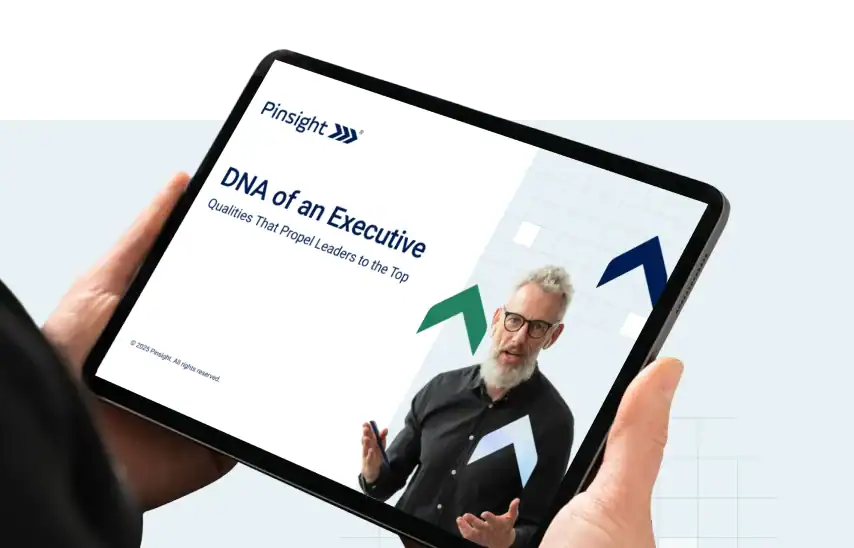
For enterprise L&D leaders seeing readiness gaps is not the challenge. Closing them is.
Leaders complete assessments, receive thoughtful feedback, and leave development experiences with good intentions. Yet when succession discussions or promotion decisions arrive months later, the same concerns resurface. The problem isn’t motivation or investment—it’s that most development stops at insight.
Pinsight was built on a different premise: readiness gaps close only when development is grounded in real behavior, focused on what actually limits success in the next role, and reinforced until change shows up under pressure.
Starting Where Readiness Gaps Actually Live: Behavior
Pinsight begins where most development efforts don’t—inside the work itself.
Rather than relying on reflection or perception, leaders are immersed in a next-level simulation that mirrors the pace, ambiguity, and decision-making demands of the role they are preparing for. What leaders say, prioritize, and decide in that environment becomes the foundation for development. See behind the scenes of an executive simulation.
This matters because readiness gaps aren’t abstract. They show up in how leaders handle trade-offs, navigate conflict, communicate under pressure, and allocate attention when everything feels urgent. By observing these behaviors directly, Pinsight creates evidence leaders recognize as real—and difficult to dismiss.
Everything that follows is anchored in that evidence.
A Development Report Designed to Drive Change, Not Just Awareness
The Pinsight Development Report is intentionally designed to move leaders forward, not simply describe them.
It begins by establishing a clear readiness narrative. Leaders see, early on, where their performance aligns with next-level expectations and where specific gaps are most likely to limit success. This framing is deliberate. It prevents leaders from getting lost in data and focuses attention on what actually matters now.
From there, the report shifts to how development should happen—not just what should change. By identifying learning preferences, development pace, and the structure most likely to sustain progress, Pinsight helps leaders and L&D partners avoid generic development plans. Development becomes targeted rather than theoretical.
Behavioral feedback is then presented exactly as it occurred in the simulation. Leaders see what they did, how it showed up to others, and why it mattered in context. Because this feedback is grounded in observed behavior rather than opinion, it tends to land differently. Resistance drops. Ownership increases.

The report also integrates work-style and personality insights to explain why certain behaviors are easy for a leader and others are harder—especially under pressure. This context is critical. Leaders begin to understand how their natural tendencies help them in some situations and create risk in others, which makes change more realistic and sustainable.

Most importantly, Pinsight narrows the focus. Rather than overwhelming leaders with every possible development opportunity, the report identifies the few priorities that will most directly increase readiness for the next role. Effort is concentrated where it will pay off fastest.
The result is a hyper-personalized development plan that translates insight into concrete action—specific behaviors to practice, habits to build, and situations where change matters most. Leaders leave knowing exactly what to do differently, not just what they should be better at.

Turning Insight into Action Through Structured Conversation
Insight alone doesn’t change behavior. Conversation does.
Pinsight recommends pairing every development report with a structured, one-on-one debrief led by a certified facilitator. These conversations are not coaching sessions in the abstract. They are evidence-based working sessions that connect observed behavior to the leader’s real role, challenges, and goals.
This is often the moment when development becomes real. Leaders ask questions, test assumptions, and translate feedback into practical next steps that make sense in their context. The structure of the debrief ensures that insight doesn’t remain static on a page—it becomes a commitment to action.
For enterprise L&D leaders, this step is critical. It ensures consistency, quality, and follow-through across participants without requiring heavy internal lift.
Reinforcing Change Until Readiness Shifts
Pinsight believes that without reinforcement, even the best development intentions fade.
That’s why the model extends beyond the individual debrief. Group debriefs allow leaders to reflect together on shared simulation experiences, normalize development themes, and learn from different approaches. Coaching programs focus on building the specific habits that emerged as readiness constraints, reinforcing change in day-to-day work.
For organizations seeking internal capability, Pinsight also enables HR and talent leaders to carry this work forward through train-the-trainer support—ensuring development conversations remain grounded in evidence and aligned to enterprise standards.
Proving That Readiness Gaps Have Actually Closed
Perhaps the most important difference in Pinsight’s approach is that it doesn’t assume progress—it measures it.
Six to twelve months later, leaders can re-enter a parallel simulation that presents the same leadership demands in a new context. This creates both a powerful practice opportunity and a rigorous reassessment of behavior change.
For L&D leaders, this closes the loop. Readiness movement becomes visible. Development investment can be defended with evidence. Succession and promotion decisions become more confident and less subjective.
Why This Works at Enterprise Scale
Pinsight closes readiness gaps because it treats leadership development as a system, not an event.
By anchoring development in real behavior, focusing effort where it matters most, reinforcing change through structured enablement, and reassessing under pressure, Pinsight creates a disciplined, repeatable path from insight to readiness.
This is not about adding more content or complexity. It’s about ensuring development actually changes how leaders perform when it matters most.